Harriet Hollister Park Update
After nearly two years of studies, public comment, and planning, New York State Parks has released its final trail plan—and with it, their decision on horseback riding at the park. I attended the meeting, asked some questions during the public comment period, and I’ve spent some time digging into the research afterward. Today, I’m going to walk you through what Parks presented, what I learned, and where I think our equestrian community goes from here.
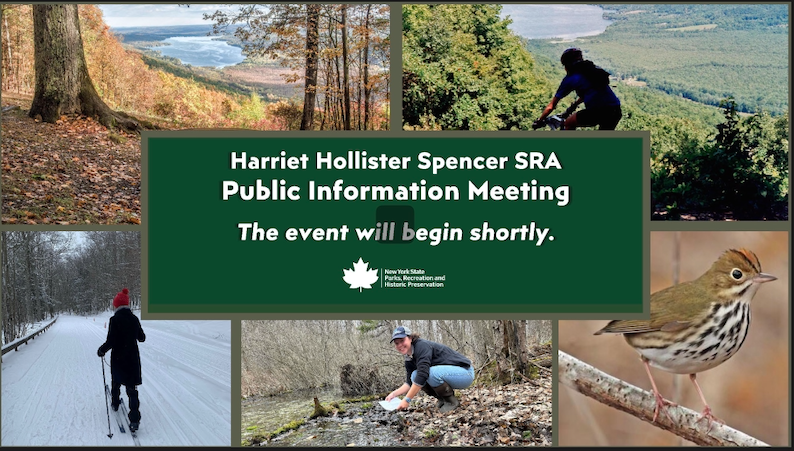
New York State Parks held their long-awaited public information meeting regarding the Harriet Hollister Spencer State Park trail review. This review has been underway for nearly two years and was prompted by several concerns the park had with its existing trail system.
According to Parks, they were dealing with a network of authorized and unauthorized trails that had evolved over many years. Trail maps no longer matched what was actually on the ground, wayfinding signage was inconsistent, and emergency responders had difficulty locating injured visitors because people couldn’t accurately describe where they were. They also cited redundant trails, maintenance challenges, and the need to better protect the park’s natural resources.
To address those issues, Parks assembled a pretty impressive team. The project included park managers, regional trail coordinators, environmental analysts, biologists, planners, and staff from the New York Natural Heritage Program. Over the course of the project, they collected public feedback, installed trail counters, conducted visitor surveys, mapped trail conditions, and completed extensive environmental studies throughout multiple seasons.
One of the biggest discoveries to come out of that work was the identification of a much larger complex of vernal pools than had previously been documented within the park. Vernal pools are seasonal wetlands that provide critical breeding habitat for amphibians like frogs and salamanders. According to the presentation, these surveys identified Harriet Hollister as one of the most significant amphibian breeding areas in New York State.
The environmental team also presented data suggesting that vernal pools located closer to trails had lower biodiversity, lower amphibian productivity, and a greater occurrence of invasive species than pools farther away from recreation. That ecological research became a major factor in developing the final trail plan.
Throughout the process, Parks also received more than 110 public comments from individuals and organizations representing hikers, mountain bikers, snowmobilers, conservation groups, and the equestrian community. They emphasized several times during the meeting that public feedback influenced the final plan.
And finally, the decision that many of us had been waiting to hear.
New York State Parks announced that horseback riding will not be permitted at Harriet Hollister Spencer State Park. They stated that after reviewing the environmental data, park infrastructure, public safety concerns, and public input, they determined equestrian use is not compatible with the property.
Whether you agree with that decision or not, the decision was made and I’d like to share some of the questions raised during the public comment period, including a few I asked myself.
So, during the public comment period I had the opportunity to ask a few questions, and I left the meeting with some that, at least in my opinion, weren’t fully answered.
First, I asked what scientific evidence specifically supported prohibiting horseback riding. The presentation included a tremendous amount of information about vernal pools, amphibians, trail safety, and environmental stewardship. But I was hoping to hear evidence that connected horseback riding itself to the conclusion that a complete prohibition was necessary. I didn’t hear that connection made during the meeting.
I also asked whether seasonal horseback riding had been considered. Early in this process, members of the equestrian community proposed limiting riding to the driest part of the year—from roughly July until the opening of shotgun season. During the presentation, Parks explained that the vernal pools are most active in the spring and that many dry up by July. I was interested in understanding whether that seasonal compromise had been evaluated and, if so, why it was rejected. I didn’t receive an answer to that question.
Another question I asked was much simpler: what is the actual penalty for someone caught riding a horse on the trails today? Surprisingly, no one could answer that during the meeting. Instead, the conversation shifted toward trail misuse and vandalism of park signage, which really wasn’t what I was asking. I simply wanted to understand what the current enforcement looked like.
As the discussion continued, I kept trying to better understand the reasoning behind the decision. From my perspective, the explanation eventually came down to more than just environmental concerns. Public feedback from other trail users who did not want horses in the park also appeared to be part of the decision-making process.
Now, to be clear, none of these questions change the outcome. Parks has made its decision. But for me, they were important questions, and they led me to spend some time afterward digging into the research myself.
What I Learned After the Meeting
I’ll be honest—when that meeting ended, I was frustrated.
I had gone into the meeting hoping to better understand how New York State Parks reached the decision to prohibit horseback riding at Harriet Hollister. Instead, I walked away feeling like several of my questions hadn’t really been answered.
It would have been easy to head home, jump on Facebook, and vent my frustrations. Trust me, I thought about it.
But rage doesn’t fuel productivity.
So instead, I stepped away, cooled off, and started digging.
I wanted to understand what the science actually says about horses and trails. Not what I hoped it said. Not what someone else claimed it said. I wanted to see the research for myself.
The first thing I realized was that there really isn’t a huge body of scientific research comparing horseback riders to other trail users. One of the most frequently cited studies comes from Great Smoky Mountains National Park, where researchers compared the surface impacts of hiking and horseback riding on several trail surfaces under both dry and wet conditions.
Their findings weren’t particularly surprising. On dry trails, one horse produced approximately the same surface impact as two to three hikers. On wet trails, that increased to roughly six to eight hikers.
That immediately raised another question in my mind.
Throughout the meeting, Parks discussed the impact of horses, but I never heard any discussion about the actual amount of horseback riding taking place in the park.
How many hikers use Harriet Hollister every day?
How many mountain bikers?
And how many horseback riders?
Those numbers matter because trail impact isn’t just about the impact of a single user—it’s also about how frequently that use occurs.
For years, horseback riders have been using Harriet Hollister, even though it was never an officially designated equestrian park. The issue wasn’t really brought to the forefront until emergency responders experienced difficulty locating an injured visitor, which ultimately led to the broader review of the trail system.
So one question I kept coming back to was this:
If a trail sees ten hikers every day and one horseback rider, does removing that one horse really change the park’s ability to sustain trail use? Does eliminating that horse simply create capacity for twelve or fifteen hikers instead?
I don’t know.
Those are the kinds of metrics I was hoping to see presented because they help put per-user impacts into real-world context.
As I continued reading, another theme kept appearing. Nearly every source acknowledged that horses have a greater per-user impact than hikers, particularly on wet trails. But those same sources also emphasized that trail sustainability depends on much more than the weight of the user. Trail design, drainage, maintenance, seasonal conditions, total user numbers, and responsible recreation all play significant roles in determining long-term trail health.
None of this means horses don’t impact trails. They absolutely do. I don’t think anyone in the equestrian community would seriously argue otherwise.
What I took away from the research wasn’t that horses are harmless. It was that sustainable trail management is rarely as simple as asking which user group creates the most impact. It’s a balance of science, engineering, maintenance, recreation, and how people actually use the trail system.
Some Hard Truths for Horse People
Now I’d like to say something that may make some people uncomfortable.
This isn’t directed at New York State Parks.
It’s directed at us.
I’ve read a lot of comments online. I’ve talked with riders who are understandably upset about loss of equestrian trail use. I’ve heard people talk about government overreach, politics, and how unfair this whole process has been.
Some of those concerns may very well be valid.
But there’s another conversation we need to have.
As horse people, we’ve earned a reputation over the years, and honestly… some of it is deserved.
Too often we only show up when access is threatened.
We organize petitions after decisions have already been made.
We flood public meetings after years of silence.
We complain when trails are closed, but we aren’t always the ones showing up with loppers, shovels, chainsaws, and work gloves to help maintain them.
And before anyone gets defensive, I’m not saying nobody does.
There are incredible horse organizations all over New York that volunteer thousands of hours building and maintaining trails. There are individuals who quietly give their time every single year without asking for recognition.
But as a community, we’re not known for that.
We’re known for wanting access.
Those are two very different reputations.
I also spent some time reading articles written by hikers, mountain bikers, and land managers about equestrians.
And honestly… it wasn’t easy reading.
The words that kept coming up were things like entitled, demanding, unwilling to compromise, and only showing up when something is taken away.
Whether that’s fair or not almost doesn’t matter anymore.
Because perception becomes reality.
If that’s how other trail users and land managers see us, then that’s the reputation we have to work to change.
Here’s the thing.
Trail access isn’t just about science.
It’s about relationships.
It’s about trust.
It’s about whether the people making decisions see you as a partner in caring for the land or simply another user asking for access.
If we only show up when we want something, we shouldn’t be surprised when we don’t have much influence over the outcome.
That’s a hard truth.
But I think it’s one we need to hear.
Where Do We Go From Here?
I’ve already heard suggestions ranging from organized protests to petitions, letter-writing campaigns, and requests to reopen the decision.
Maybe those ideas have merit. Maybe they don’t.
Personally, I’m not convinced that’s the best place to start.
The decision has been made. Protesting outside the park may let Parks know we’re disappointed, but I’m not sure it changes anyone’s opinion. If our goal is simply to make noise, then a protest will certainly do that. But if our goal is to improve the future of trail access for equestrians across New York, I think we need to think a little bigger.
Over the last couple of weeks, I’ve been asking myself a simple question:
What kind of trail user group do we want to be?
Do we want to be known as the group that only shows up after a decision has been made?
Or do we want to be the group that land managers, conservation organizations, and state agencies genuinely want sitting at the table before those decisions are ever made?
I’ve come up with a handful of ideas, but I don’t pretend to have all the answers.
Maybe the answer is organizing more volunteer trail work days—not just on horse trails, but anywhere we’re welcome to lend a hand.
Maybe it’s building stronger relationships with conservation organizations and supporting habitat restoration projects, even when horses aren’t directly involved.
Maybe it’s encouraging more equestrians to attend public planning meetings before decisions are finalized instead of after.
Maybe it’s educating ourselves on the science so we can have informed conversations rather than emotional arguments.
Or maybe it’s all of those things.
One idea that’s been rolling around in my head is organizing a volunteer work day at Harriet Hollister itself. As many of you know, I serve as the Finger Lakes Regional Director for the New York State Horse Council. Rather than spending regional funds on another meeting or event, what if we used those funds to sponsor a trail work day?
Think about the message that would send.
A group of horseback riders volunteering their time to improve a park they can’t even ride in.
Would it change the decision overnight?
Probably not.
Would it change how equestrians are perceived?
I think it just might.
So rather than tell everyone what I think we should do, I’d rather ask you.
Over the next week, I’m going to put together a community survey and I’d like every Rochester Trail Riders listener—and really anyone who cares about trail access—to participate.
I’ll lay out several possible paths forward. Maybe you believe a protest is the right approach. Maybe you’d rather see volunteer trail work, conservation partnerships, educational outreach, or something I haven’t even thought of yet.
I genuinely want to hear from you.
Because this isn’t my community.
It’s our community.
And whatever comes next shouldn’t be driven by one person’s opinion. It should be driven by the people who care enough to be part of the solution.
Harriet Hollister may be one chapter in a much larger story.
The reputation we build as equestrians over the next five, ten, or twenty years will influence opportunities at parks all across New York.
I’d rather spend my energy building that reputation than arguing about the one we’ve already lost.
So let’s have the conversation.
Let’s listen to one another.
And then let’s get to work.
Discover more from Rochester Trail Riders
Subscribe to get the latest posts sent to your email.