Big Bale Buddy – Round Bale Feeder

Re-Post permission from AlpacaBytes.com

This year (Fall 2009) I decided to feed round bales to the horses to help keep my chores to a minimum and to make sure the skinny boys have hay 24/7 so they fatten up for me.   Last year I fed the bales as is and had a ton of waste.  One bale would only last me 6 days for 3 horses and the waste I had to clean up in the spring was horrendous.  I thought about traditional round bale feeders and some newer models that resemble doll houses if you ask me. 

The biggest problem I had with almost every single feeder was the ability for a horse to get a leg stuck.  I have 2 horses who insist on putting their feet on or into anything they possibly can so that ruled out almost every single round bale feeder I found.  Expect for one, the Big Bale Buddy.

I purchased the “Large” size which is said to fit a 4’5” to 5’2” diameter round bale.  Good thing too because the ultra bargain 700lb round bales I got for $12 each were 5 footers.   Note: this product ships from Canada and does take a full 10 days or so to make it to you.

Putting on the Big Bale Buddy:
Reviews I read said the first time putting it on would be a real chore.  Well if you have a helper it isn’t so bad.  My hubby and I managed to get the Big Bale Buddy on in 2-3 minutes or so.   I’d imagine putting it on by myself would have been a lot more involved.

We hauled the bale out to the field and flipped it upright and finished pulling the Buddy snuggly up to the top so it fully covered the bale leaving the top open. 

The horses were a bit confused by it at first and cautiously approached the Big Bale Buddy.  Once they figured out it was a food dispenser it didn’t take long for them to warm up to it.  Of course it instantly turned into a scratching post and everyone took turns doing neck and butt scratches on it. 

Since there’s still a tiny bit of grass left in the pasture the bale isn’t overly interesting as a food item yet.  I’ll be sure to keep this post updated as the bale gets eaten.

5 Horses vs 700lb round bale in a Big Bale Buddy
=====================================
Day 1:
So far the bale is holding up really well.  Instead of it unraveling and the horses digging through it, trapling, peeing, and pooping on it the bale looks just as good as when I first put it out there.  The only waste is nothing more than a handful scattered around the edge.  No rips or tears in the Buddy either. 
=====================================
Day 3:
I’m amazed on how much hay they’ve eaten and how little waste there is.  They have been eating around the core and all the slack just falls into the bag. The little waste that has fallen out of the bag I picked up and tossed over the fence to the alpacas.  They happily ate the rest.  Last year 3 horses would eat through a 700lb bale in 6 days.  Now without all the waste the same size bale is easily feeding 5 horses.
=====================================
Day 6:
Rain in the forecast today.  I decided to move the bale into the run-in shed to keep it dry.  Oh yes I said move it.  The Big Bale Buddy has kept the bale in tact enough that we were able to tip it over onto the carry-all and relocated it.  The bale is about 2/3 eaten, I’m guessing theres about 300lbs left.  There’s hardly any waste, just a small ring of hay around the bale.  Funny observation…. There was a ring of poop 1 horse length all the way around the bale.  Without the buddy the bale would have been ripped apart, spread around and all that poop would have been on good hay.
6 Day Old Round Bale
=====================================
Day 7 & 8:
Well the bale fully collapsed on itself and there was just loose hay left in the bottom.  I picked up the buddy and dumped the rest of the hay in an empty stock tank I use to feed flake hay in. By morning all the hay was gone and it was time to put out a new bale. I totally love this product, so easy to use, and the only hay feeder that I’ve seen that actually allows the horses to eat all of the hay without wasting any of it. 
=====================================
2nd Bale:
The 2nd bale I put out lasted 7 days with the 5 horses eating it 100% without access to the pasture any more.  They emptied every ounce of hay from the bag.  When the bag is empty they walk on it and dig through the folds looking for that last little leaf. None of my horses will be afraid of tarps after feeding with the bale buddy I’m sure! 
=====================================
12/4/09:
It’s that time of year where the paddock is solid shoe sucking mud. YUCK.  Good news though. Dry hay! My bale buddy is no longer green and is caked in brown mud but the hay inside it is clean and dry.  Hay was eaten right down to the last little nibble again.
=====================================
12/31/09
Well my only worry about the Big Bale Buddy came to light the other day.  When the bale gets to the end you have a mostly empty bale and the horses poke through it for the last bits.  I was worried that when they step in it they could get a leg caught and I was right, kind of.  My new spookie horse “The General” wanted to come over for a treat and wasn’t smart enough to pick his feet up when walking out of the bag so the bag came with him.  Normally this horse bolts at the sight of a plastic bag but he seemed totally unconcerned about the buddy stuck to his hoof.  About 3 steps later he fianlly got annoyed with his shadow and picked his foot up and out of it.  I’ve decided not to think of it as a scary posibility any more but more of a Bale Buddy training aid! :o )

=====================================
1/8/10

=====================================
3/6/10
Spring thaw.  The pasture is off limits and the buddy is now in the middle of our “mud” paddock.   With the snow pack melting during the day and freezing at night the mud is DEEP. The buddy looks to be sunk in 4-6″ into the mud.  The good news, the hay inside is dry as can be.  This time last year the hay would have been stepped on and squished into the deep mud making even more of a mess and wasting more than a 3rd of the bale.  
We had a really cold winter and when it got down to -11 at night the horses ate double time and I had to feed 1 bale every 5 days for a few weeks.   I decided to pick up a few more bales today just in case.  These new bales are HUGE 5×5 1,000lbs guys and are way to big for my “Large” size buddy.  I’m seriously thinking of buying the XL Buddy so I can easily feed these few bales.  I don’t even want to think about feeding hay without my buddy any more.
 

Buy Your Bale Buddy Locally @ AlpacaBytes.com

Shredded Straw Bedding

Recently we purchased a Wallenstein BXM Chipper Shredder to help with chipping all the trees and scrub brush we took down in our soon to be new orchard area. When considering buying a chipper we thought about going all out and getting the shredder to see if we could make our own livestock bedding.

If you’ve read my past posts about my experiences with different types of bedding you’ll know my distain for straw. I just hate picking through traditional straw bedding.  The waste is just awful, it takes me much longer to muck a stall and once I get it out to the manure pile it takes forever and a day to compost.  The price of straw vs. the wood pellet bedding I’m using now is night and day and right now I need to bring down the cost of doing business.

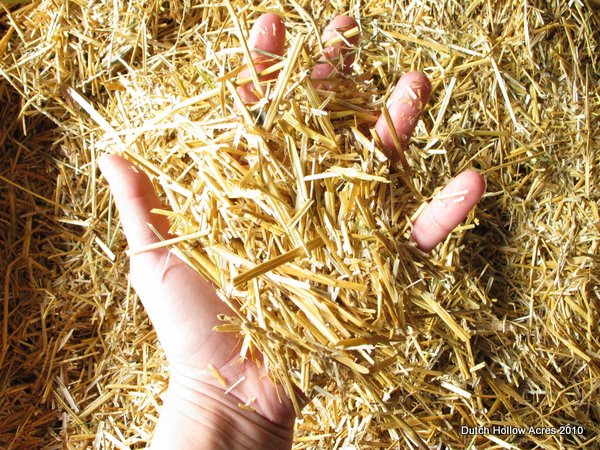
In comes the shredder.  I’ve read about how shredded straw composts faster and is used at some dairy farms and also by mushroom farmers.  So I decided to give it a try.  I purchased a 500lb bale of straw for $40 and fired up the shredder.  We aimed the shoot into our little red TSC dump trailer, stood up wind from the shredding and let her rip.  3.5 of the big flakes of straw filled the dump trailer really quickly and  it filled one of our 11×11 stalls.  1 trailer full gave a great 4-6” deep bedding and covered the whole stall evenly.  For comparison 4 ($7) bags of wood pellets gave me the same results.  That’s $28 for pellets vs $8 for shredded straw. At this point I have a really big smile on my face.

With pellet bedding I have to add 1-2 bags per week for a stall with a mare and foal.  There’s very little waste and I only have to take out the soiled areas.  I know from past experience that with traditional straw bedding 3 flakes of straw would give me nice bedding but I had to strip the bed every day and add another 3 flakes.  How would the shredded straw do?

Shredding the straw brought down the stalk size to 2-3 inches in length and even broke the stalk open so it no longer was a tube.  The result is a very light fluffy bedding that sifts right through my favorite Dura stall fork just like wood shavings would.  It doesn’t fall though like pellet bedding but with a few shakes of the fork the horse apples remain and the clean bedding falls through.  Pee areas are sucked up nicely and are easy to spot and scoop up with minimal waste.  I managed to pick through 3 stalls using just 1 wheelbarrow! Try that with traditional straw bedding!

Shredded Straw

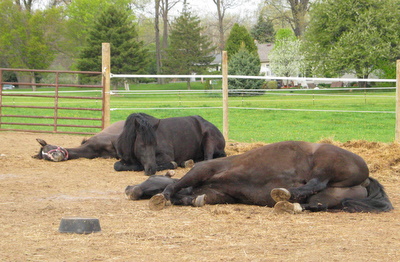
Do Horses Sleep Standing Up?

The truth is, no.  Horses do not sleep standing up.  Adult horses will rest standing up and look quite out of it but they cannot “sleep” standing up.  For a horse to actually achieve REM sleep they must lie down and be stretched flat out on their sides.  REM (Rapid Eye Movement) sleep is a deep dreaming sleep and a horse standing up with locked legs would surely fall right over or sleep walk/run.

How much sleep do horses get?  With my small herd I’ve noticed many different personality types and their sleep habits.  Here is how each of my horses sleep.

Jasper: I have yet to see this old boy sleep during the day.  He’s middle of the herd hierarchy and spends most of his day trying to make it to the top of the pack.  Come night fall he finds his “spot” and conks out for a good 30 minutes and seems to get 2 long sessions in overnight.  

The General: This poor boy is at the bottom of the food chain and always gets picked on.  He really wants his beauty sleep and when he can he lies down and tries to get a few Z’s  Since his sleep is usually interrupted I find he sleeps more frequently in 24hrs but for shorter periods of time maybe only 5-10 minutes.

Fay: This cute little filly is higher up on the latter than the 2 previous boys and is 1 of 2 girls in the group under the watchful eye of the herd leader, Goliath.  Being young she resorts to being the snot that likes to wake The General up and chase him around.  She rests throughout the day and I only see her take 1 lie down nap at night.  Come warm spring weather she does lie down more frequently and really enjoys her sun baths. 

Cotton: Cotton is 2nd highest on the food chain and the beloved girl friend to Goliath the leader.  She has the ability to nap whenever she wants, where ever she wants and for as long as she wants. I notice she chooses to only take maybe 1-2 short 5-10 minute naps during the day and one long one late morning just before sunrise in the safety of her stall.  I’m usually the one who wakes her up in the morning. 

Goliath:  The leader of the pack and the laziest horse in the group. Since he is the big cheese no one ever bothers him and he can sleep for as long as he wants.  Most vets will tell you that a horse that is lying down longer than 30 minutes should be checked on because the weight of the animal will start to crush its innards.  Apparently Goliath could care less about science and takes record breaking 1-2hr naps.  I’ve gone out and poked him on several occasions just to make sure he’s doing ok.  He appeases my pestering by rolling over and lying on the other side instead.  I’ve noticed that the rest of the herd usually takes the “it’s time to sleep” queue from Goliath.  Jasper is the one who stands guard while the others get a few precious minutes in.

Until recently I wondered if horses legs would fall asleep like ours do when they fold them up under themselves to sleep.  Even after a long nap they always seem to stand right up and walk off without so much as a hitch in their gait.  That was until just a few weeks ago.  I had woken Cotton up from her morning slumber and she bolted up to a standing position.  This morning something was off, she kept picking up her hind right leg and shaking it and then would pound it on the floor.  Ah ha!  Her hind leg had fallen asleep!  After a few good shakes and stomps on the ground the pins and needs must have subsided and she put full weight on it and came over for treats.
(Left to Right)  Faye, Cotton, Goliath

Farm Tails – Case Of The Missing Feed Tub

I just love caring for horses.  Most folks probably don’t know that each one has their own personality just like the cats and dogs we call our pets.  It’s the individuality of each horse that I care for that makes me smile every day.

I feed my horses in the indestructible flexible rubber tubs.  These tubs are the greatest things since sliced bread, horses can step and invert them, tractors can run over them and they are still in perfect shape when it comes time to feed a meal.  That is if you can find them!

This morning I went out to feed breakfast and made my way from tub to tub scooping out grain but this morning I was short one.  I looked in all the usual hiding places but alas, my tub had vanished.  I felt bad for the last horse in the group, he ended up eating his grain off the snow.

I went about the rest of my chores feeding all the alpacas, tossing out hay and had totally forgotten about the missing tub.  That was until it came time to water everyone.  The horses have a 100 gallon stock tank for their water supply and it needs refilling once or twice a day depending on how much hay the fatties eat. I came out with the hose to fill up the tank and to my surprise there was the missing tub.

My absent tub was floating perfectly on the surface of the water in the tank and looked like a little boat.  The only conclusion I could come up with is that the 3 year old Filly Fay, had placed it so gently and perfectly in there after getting thirsty.

Fay really likes the feed tubs and they seem to act as a pacifier.  She likes to pick one up and happily walks around with it in her mouth. It seemed that last night she had wandered around with her tub, got thirsty and placed the tub on the water to take a drink.  I sure got a good laugh finding the rubber tub boat floating in there.

Extracting the tub, I shook off the water and tossed it back out with the others in the paddock.  Of course Fay immediately had to investigate and picked up her trusty tub and wandered off with it.  I wonder where I’ll find it tomorrow.

Winter Riding Tips – Post Ride Care

 Most of our horses here in WNY are built for the cold.  They are very fuzzy this time of year with thick winter coats to keep them warm in sub zero temperatures.  These winter coats are great for battling the cold but not so great for exercising under saddle.  Often just a light ride with friends out on the trail can work up a sweat for your horse.  Be sure to care for your equine friend the right way after your ride.

–       End you ride with a nice long walk on a road or packed snow if possible.  Just walking through deep snow is quite a workout. Your horse can get pretty warm even with a simple walking ride.

–       A sweaty horse after a ride is a cold horse.  Do your best to dry your horse off and use a fleece cooler to help draw the moisture away from their body while keeping them warm.  Do not turn your horse out until they are dry!  Because of the cold it will take longer than normal for a horse to dry off.  Be prepared to have your horse cooling off in a stall for 1-2 hours after your ride before they are dry enough for turn out.

–       Clipping your horse.  Depending on how much winter riding you do you might find it beneficial to clip your horse.  This will help them regulate their temperatures better during winter work so they aren’t prone to sweating.  Just be sure to follow proper blanket management for the type of clip chose for your horse.

–       Offer warm water.  Hot horse drinking cold water could cause colic.  Wait until your horse cools down and offer them heated water.  Either boil some in a teapot and add to a bucket or better yet use heated buckets! 

–       Dehydrated horse? Believe it or not most horses like Gatorade (mine like orange flavor).  The sweetness of a few scoops of Gatorade in their water bucket entices them to drink up and the added electrolytes help their system rebalance.

Winter riding is a blast and there is nothing more beautiful than enjoying a fresh snow on a crisp winter morning.  Ride Safe.

Winter Riding Tips – Hoof Care

So you want to enjoy your horse during the winter months but every time you hit the trials your horse’s hooves fill up with hard snow making the bottom of their feet look like a snow cone.  Not the safest of situations.
There are several ways to keep the snow from packing up in your horse’s feet

Cooking or Silicone Spray – This offers a temporary solution and is really easy to apply. Just pick up the foot, brush it clean and spay. Usually this method will prevent the snow from packing up in the hoof for 5-10 minutes.

Full Hoof Snow Pad
– Made of hard plastic
Pros – You will never have to worry about snow building up in the hoof, period!
Cons – You can’t see the hoof! What’s going on under there

Silicone Snow Pad – A ring of silicone that fits between the hoof and the shoe.

Pros – you can see the bottom of the hoof and clean under the pad
Cons – This pad still can allow snow to build up if it packs up under the pad and is horrendous to clean during mud season

Horse Hoof Boots
– My personal favorite  Choose your style and manufacturer there’s tons of them out there. Your horse can still be turned out barefoot and strap the boots on when you need them. I personally like the Old Mac’s because of the hiking boot type tread that is on the bottom which gives better grip.